
244, 1st Main Rd, near Rajkumar, Kasturi Layout, Kaveri Nagar, Basaweshwara Nagar, Bengaluru, Karnataka 560079
08:00 am - 10:00 pm Monday-Saturday
244, 1st Main Rd, near Rajkumar, Kasturi Layout, Kaveri Nagar, Basaweshwara Nagar, Bengaluru, Karnataka 560079
08:00 am - 10:00 pm Monday-Saturday
ICT / DCT

Ict / Dct

₹ 1200 ₹ 900 30% OFF
Booking Assistance Online
Need help? Chat with us on WhatsApp
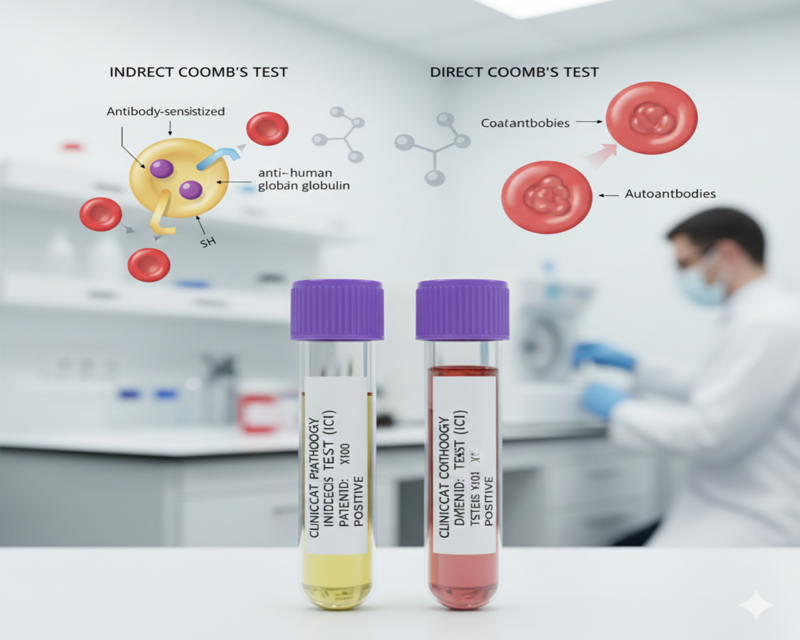
The Coombs Test (Direct and Indirect) is used to detect antibodies against red blood cells (RBCs). Direct Coombs Test (DCT): Identifies antibodies attached directly to RBCs. Indirect Coombs Test (ICT): Detects free antibodies in the serum that may bind to RBCs.

Sample Type

Blood

Includes

16 Parameters

Report

Within 24 hours

Performed by certified phlebotomists

Indirect and Direct Coombs Test Overview

The Coombs test is an immunohematology assay used in blood transfusion medicine and autoimmune hemolytic anemia diagnosis.

Direct Coombs Test (DCT):

Detects antibodies or complement proteins bound to the surface of RBCs.

Used in diagnosing autoimmune hemolytic anemia, hemolytic disease of the newborn, and transfusion reactions.

Indirect Coombs Test (ICT):

Detects antibodies present in the patient’s serum that can bind to RBC antigens.

Used in cross‑matching blood before transfusion and in prenatal testing for Rh incompatibility.

Both tests are critical for safe blood transfusion practices and for identifying immune‑mediated hemolysis.

ormal Result: Negative (no antibodies detected).

Abnormal Findings:

Positive DCT: Indicates autoimmune hemolytic anemia, transfusion reaction, or hemolytic disease of the newborn.

Positive ICT: Indicates presence of alloantibodies in serum, risk of transfusion reaction, or maternal antibodies against fetal RBCs.

Clinical Use:

Ensures compatibility in blood transfusions.

Detects immune‑mediated destruction of RBCs.

Supports diagnosis of hemolytic anemias and Rh incompatibility.